Stephen & Burns Salon Spa and Boutique in Burlington is celebrating the lake by hosting a Service-a-thon from 11:00 AM until 4:00 PM on April 18th to benefit LCC’s work. For $35 you can give yourself -- and the lake -- a lift with a stylish haircut, cleansing facial, or rejuvenating massage. Advance reservations at 802 865-4766 are recommended to ensure you get an appointment. Click here for a map to the salon at 116 Church Street.
LCC Lake Ripples - April 2010 E-News
Lake Ripples - April 2010
LCC's E-News Bulletin
Sunday April 18th Service-a-thon for LCC at Stephen & Burns
Posted Friday, April 9, 2010
—
GeneralCut Your Locks for the Lake This Sunday ~<br> O’Brien’s Aveda Institute Cut-a-thon to benefit LCC!
Posted Friday, April 9, 2010
—
GeneralFeeling a bit shaggy? Are your locks too long? Is your coif in need of shaping? Get your hair cut or trimmed on Sunday April 11th and help LCC and the Lake! Head to O'Brien's AVEDA Institute at 1475 Shelburne Rd in South Burlington between noon and 4:00 PM for a cut-a-thon to benefit the Lake Champlain Committee. Look good and feel even better by helping to safeguard Lake Champlain. When it comes to our water source we are all "localvores." A minimum donation of $10.00 per haircut is requested with all funds going to LCC! Click here for directions to the cut-a-thon location.
April 22nd Walk for Water ~<br> Step out with Stylists for an Earth Day Stroll
Posted Friday, April 16, 2010
—
General
Photo from morguefile.com
Join Aveda representatives, local stylists, and others for an Earth Day walk from Burlington’s Church Street to North Beach and back. The walk is part of Aveda’s global initiative that acknowledges the daily struggle of more than one billion around the world who do not have access to clean water. The Lake Champlain Committee has been chosen as one of Aveda’s 29 global partners in this effort to raise funds and awareness about the need to protect and improve water quality. The Earth Day walk will start at 9:00 AM at Stephen & Burn’s Salon at 116 Church Street. The walk length will be about six kilometers – the average distance that women in developing countries walk to collect water each day. So step out with the stylists, bring your friends and family and join in a waterfront walk for water. You’ll get some exercise and pick up some water tips along the way. All are welcome!
April 22nd Artists Get Wet Again ~<br> Lake Champlain in Paints and Words
Posted Friday, April 16, 2010
—
General
A Beautiful Day on the Bay<br> by Libby Davidson
Thursday, April 22nd from 6:30 – 8:00 PM
at Phoenix Books and Café, Essex Vermont
Lake art, literature and natural history will be served up with light refreshments at Phoenix Books and Café in Essex, Vermont on Thursday, April 22 from 6:30 – 8:00 PM. The event is co-sponsored by the Lake Champlain Committee (LCC), the Essex Art League, and Phoenix Books and Café in celebration of Earth Day. Over 20 area artists will exhibit their diverse visions of Lake Champlain. LCC author and staff scientist Mike Winslow will give a reading from Lake Champlain: A Natural History and provide tips for citizen actions to protect water quality. Poet and novelist Daniel Lusk will read from his collection of lake poems and give an audio visual presentation inspired by Lake Champlain.
All artwork will be for sale. The event is free and open to the public. Attendees are invited to join in for a few minutes or the entire evening. For directions click here.
April 23rd and 24th EMS Club Day for Outdoor Enthusiasts
Posted Friday, April 16, 2010
—
General
Photo by Kevin Rose
Eastern Mountain Sports is hosting a special club day event to give back to the community. On April 23rd and 24th members of outdoor clubs and organizations like the Lake Champlain Committee will receive 25% off all EMS brand gear and 20% off everything else in the store! Bring this email as proof of membership (if you’ve renewed your LCC support this year). If you get restless while shopping you can check out the climbing wall set up in the parking lot. Click here to find the store nearest you.
Help discover vernal pools-<br> April Training for Citizen Scientists
Posted Friday, March 19, 2010
—
General
Vernal pools are an important breeding ground for many amphibians. Photo by esagor via Flickr
Scientists at the Vermont Center for Ecostudies are attempting to identify and protect vernal pools in the state. Vernal pools provide critical breeding habitat for many species of frogs and salamanders. They fill with water as the snows melt but dry up in the heat of summer. The project is in its second year. Workshops will be held throughout Vermont to train volunteers to recognize and document vernal pools. Then the volunteers will be asked to field-check previously identified pools, collect biological and physical data, and report locations of unmapped vernal pools.
This year, the effort focuses on the Champlain Valley, central Vermont and the Upper Valley. Space in the workshops is limited, so interested people are asked to pre-register. Workshops will be held:
- April 20, 5-8 PM, Green Mountain Audubon Center, Huntington, e-mail, michael@arrowwoodvt.com
- April 26, 5-8 PM, Ripton Elementary School, Ripton, email sfaccio@vtecostudies.org
- April 27, 5-8 PM, Marsh-Billings-Rockefeller National Historical Park, Woodstock, email sfaccio@vtecostudies.org
- April 29, 5-8 PM, North Branch Nature Center, Montpelier, e-mail michael@arrowwoodvt.com
For more information visit http://www.vtecostudies.org/VPMP/
Cold Water Caution
Posted Friday, April 16, 2010
—
General
Photo by Jonathan Long
Even if air temperatures seem balmy, the lake takes much longer to warm up. Additionally, strong currents and the presence of springtime debris add to risks this time of year. Current Lake Champlain temperatures are in the low 40s. If you are immersed in water that cold for less than a half hour, exhaustion and unconsciousness can set in. Water temperatures of less than 70 degrees Fahrenheit can cause you to lose precious body heat up to 25 times faster than comparable air temperatures. Water temperatures in many areas of Lake Champlain, particularly the Main Lake, never reach the 70s. Be cautious about heading out on the water and make sure you and your boat are properly equipped. Bring a weather radio or VHF with you and check the weather forecast repeatedly. Always wear a Personal Flotation Device (PFD). Nine out of ten drownings occur in inland waters, most within a few feet of safety. Most of the victims owned PFDs but died without them. A properly fitted, buoyant PFD can save your life, but only if you wear it. Dress for the season. If kayaking or canoeing in cold water conditions (no matter what the air temperature is) wear a wetsuit or drysuit with an insulating layer. Here's to safe, fun adventures on the water.
Clean Lake Earth Day Request ~<br> Take the Lake Protection Pledge
Posted Friday, April 16, 2010
—
General
We can create a cleaner lake – with your help! Some of the pollutants that trigger algae blooms, close beaches and cause other problems in the lake come from our own homes and driveways. Taking simple actions such as picking up after your pet, using non-phosphorus dishwasher detergent, and repositioning gutters to drain onto grass, soil, or to rain barrels will help prevent nutrients, sediments and toxins from getting into the water from your household. You’ll find these and other tips on our website where you can also sign up to “Take the Pledge” and commit to protecting water quality. It’s a great action to take on Earth Day!
Healthy Lawn Tips
Posted Friday, April 16, 2010
—
General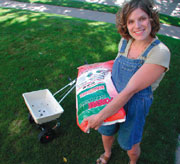
Photo from Lawn to Lake website
Follow these easy tips for a beautiful green lawn, not a green lake! For more information on how to care for your lawn and the lake - including retailers that carry phosphorus-free fertilizer -- check out the Lawn to Lake website www.lawntolake.org.
FERTILIZE...
- Only with phosphorus-free fertilizers. Most northeastern lawns and 75% of Chittenden County VT lawns tested by the University had enough phosphorus (P) and only need nitrogen (N)!
- Apply fertilizer once/year-the best time for this region is early fall.
- Sweep up fertilizer from sidewalks and driveways. Don't fertilize before heavy rain.
LOOK FOR THE MIDDLE NUMBER...
- On fertilizer bags to see the N-P-K nutrient analysis. The middle number is the phosphate (phosphorus) content. A "zero" in the middle means it is phosphorus-free. Lawns rarely need extra potassium (K), but adding some does not affect water quality.
TAKE A SOIL TEST...
- If you are seeding a new lawn, or want to learn more about your lawn's nutrient content, pH level and organic content.
WATER...
- If desired, in early morning, when there is less than 1 inch/week of rain. Grass will survive droughts without watering by going dormant.
PLANT GRASS SEED...
- On existing lawns in the fall and spring to out compete weeds.
- Use a grass mixture that does well in the setting (soil, light, activity).
- Leave legumes, such as common white clover, among the grass to add nitrogen, which will naturally fertilize your lawn.
MOW...
- To maintain a height of 3 to 4 inches and cut off no more than 1/3 of grass blade. Leave clippings on lawn to add nutrients and organic matter, but be sure to sweep the clippings off pavement.
WEEDS...
- Will be discouraged by following these healthy lawn tips! Just pull any that are left by hand.
Natural History Note – Upside Down Snails
Posted Thursday, April 15, 2010
—
GeneralPaddlers on quiet back waters may notice multitudes of snails floating upside down near the surface. However, close inspection will reveal that the snails aren’t floating, they’re crawling. The snails actually have the ability to attach themselves to the underside of the surface film and propel themselves forward; all the while feeding on the detritus and algae along the surface just as they would along the glass in a fish tank.
Apparently the snails’ slime attaches to the water. They then can vary the thickness and texture of the slime trail by creating ripples in their foot as they lay it down. The varied texture allows the snails to propel themselves forward.
Snail slime is being studied by various teams of engineers who hope to create robots that can walk up walls or over water. Other teams see the secrets of snail slime as providing clues for developing glues that stick to wet surfaces.

Lake Look ~ The Tugboat McAllister
The week of November 17, 1963 newspaper headlines were occupied with the recent return of a Yale professor after more than two weeks in a Soviet prison where he had been accused of spying. Triplet cows were born on a West Chazy farm. President Kennedy was preparing for his upcoming visit to Dallas. Vermont Governor Phil Hoff was calling for a consolidation of school districts in Vermont. Slipped into page three of the Wednesday edition of the Plattsburgh Press Republican was a notice that a tug boat had sunk on Lake Champlain the previous Sunday.
At 11 PM on Sunday November 17, 1963 the tugboat William H. McAllister was towing an empty oil barge when it struck Schuyler Reef. According to the press report, “It was crushed past aft of midship on the port side.” The boat went down within five minutes, forcing the eight crew members aboard to abandon ship and make for the barge. They anchored the barge and spent the night aboard it. Reports of how they finally reached shore conflict. The Press Republican said, “Early Monday morning a southbound boat saw their distress flare and picked them up.” The Burlington Free Press said, “The barge, with no power of its own drifted a half mile down the lake before hitting shore.” MORE
LCC Links
- Upcoming Events
- Join/Donate