Lake Champlain Committee - Working for a healthy, accessible lake since 1963

Lake Ripples - Autumn 2009


LCC's E-News Bulletin
Crown Point Bridge Closure


The Crown Point Bridge was closed on October 16th due to safety concerns. Photo by Lori Fisher

In late September, LCC celebrated its 46th annual meeting as part of the Crown Point Quadricentennial and Festival of Nations. The Crown Point Bridge was an integral part of the bi-state events. Thousands of participants crisscrossed the lake in cars and on foot to take in music, theater, films, and natural and cultural history programs at Chimney Point and Crown Point State Historic sites. Less than a month later, the bridge was abruptly closed indefinitely when inspectors discovered that at least two of the 80-year old concrete piers were in danger of collapse.  

The effect was immediate and severe in an area where people live on one side of the water and work on the other, farms straddle state lines, and businesses have been built around cross lake traffic. Commutes have more than doubled in time and money, employees have been laid off, and some people have resorted to boating across the lake in the dark to get to and from work.  

The bridge symbolizes the connectedness of Champlain Valley residents. Its closure has brought to light one fact that sometimes gets ignored – our shared reliance as a lake community. What happens on one side of the water affects the other. Recognition of our interconnectedness will not only help us address the transportation challenges at hand but should also inform all our environmental policy decisions from reducing nutrient loading to combating invasive species.  

Give a Lake Gift


This colorful art print can be purchased at LCC’s office or online.

Check out LCC’s Lake Shop for the perfect present for a fellow lake lover. We have lake note cards, art prints, and a great natural history book to help you celebrate friendships, thank a host, stuff stockings, and remember the holidays. You can also give a gift membership. Recipients of a $40 membership will be notified of your gift in December and sent the 2010 Lake Champlain Paddlers’ Trail Guidebook in June. Recipients of a $55 membership will receive an autographed copy of LCC’s award winning natural history book in December and the 2010 trail guidebook in June. Just fill out the online new membership form, check the “gift membership” box, and we’ll do the rest!

Substantial Mudpuppy Mortality Observed
During Lamoille River Sea Lamprey Treatment


Photo from Wikipedia

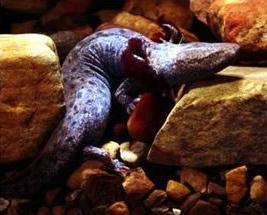
The largest known population of mudpuppies on Lake Champlain was found recently in the Lamoille River when over 500 of the reclusive nocturnal amphibians were killed by chemicals added to the river to kill sea lamprey. It is unknown how many mudpuppies survived. Mudpuppies, particularly juveniles, are known to be susceptible to the lampricides and have been affected by many treatments around the lake. Fewer than 200 mudpuppies were killed in the largest prior die-off on the Ausable River.  

Mudpuppies are large salamanders that never lose their external gills. They spend their entire lives in the water and populations are extremely difficult to survey. They feed principally on small invertebrates. They are long-lived and do not reproduce until they are about six years old. The first mudpuppy ever described by science came from Lake Champlain. In 2002 the state of Vermont’s Reptile and Amphibian Species Advisory Group recommended that mudpuppies be listed as threatened in Vermont, but the Agency of Natural Resources did not accept that recommendation.  MORE

Learn about the Lake on November 11th
5 pm at the Hawkins Hall Room 153C, SUNY Plattsburgh


Photo by Carolyn Bates

LCC Staff Scientist Mike Winslow will discuss the historic and on-going cooperative efforts to protect Lake Champlain. Learn more about the lake, what is being done to restore its health, and how you can make a difference in Lake Champlain’s future, during this free evening program. Click here for directions to Hawkins Hall. Co-sponsored by the Lake Champlain Committee and the Lake Champlain Research Institute.  

Can’t attend but want to learn more about Lake Champlain? 
Purchase a copy of LCC’s award-winning natural history book through our Lake Shop.The 160-page publication covers the lake’s geology, geography, biology, and ecology in an accessible, engaging style. It makes a great gift for friends, family, fellow lake lovers or yourself!

Lake Friendly Homecare Tip


Photo from morguefile.com

Keep the lake in mind when loading your automatic dishwasher and use phosphorus-free detergent. Check the labels on the products you buy to ensure the brand you choose doesn’t include phosphorus to avoid sending excess nutrients into our waterways.  

Research and lobbying by LCC led to passage of legislation in Vermont to ban phosphates from household dishwasher detergents in 2010. Similar legislation in NY was introduced earlier this year (S.3780 and A.8914) but has not yet passed. According to independent studies by Consumer Reports, phosphate-free automatic dishwasher detergents work as well as those with phosphates.  

For more lake friendly tips, check out the Learn and Get Involved sections of our website and consider taking our Lake Protection Pledge.

Natural History Note –
Blue Green Algae in Winter


Blue green algae in Malletts Bay. Photo by Angela Shambaugh

As summer fades to winter blue-green algae blooms become but a memory.   But what actually happens to the algae? Well, it depends on the species. Some blue-green algae produce specialized resting cells called akinetes that settle to the bottom of the lake and essentially hibernate through the winter. Development of akinetes is triggered by both declining light levels and declining temperature. Other blue green algae produce colonies that are either buoyant or not. As winter approaches, change in light and water temperature lead to an increase in proportion of non-buoyant colonies. These cells settle to the bottom where they continue to remain active and even divide, though at a much reduced rate. Come spring, when wind and wave stir the bottom sediments, the algae are re-suspended. Models developed in the Netherlands suggest that if there were no recruitment of algae from the bottom, summer blooms would be reduced by 50%.

Lake Look ~ Rainbows


Light entering a raindrop is bent and then reflected off the back of the drop. Different colors bend to different degrees producing the rainbows we see. Diagram from wikipedia

In early October, a rare meteorological phenomenon provided a treat for people lucky enough to be near the Crown Point Bridge. The waters north of the bridge became suffused with rainbow colors. Though everyone is familiar with rainbows arcing in the sky, seeing them sitting atop the water is much less common.  

Rainbows form when the sun’s rays pass through water droplets and reflect back to an observer. Once the light enters the water droplet it bends, with different wavelengths varying in the degree to which they are bent. Reds bend 42 degrees while blues bend about 40 degrees. The light then bounces off the back of the water. Thus in order to see a rainbow, light must shine from behind the observer while water droplets are in the air in front of the observer.  

In order to see the different colors of the rainbow, light must reflect off different water droplets. Those slightly higher in the atmosphere reflect reds, while the lowest droplets reflect blues. MORE

Visit lakechamplaincommittee.org to explore, learn, get involved and more!