Don’t Move a Mussel: The Growing Threat of Invasives, from Zebra to Quagga
December 2025 Lake Look
In 1993, 13-year-old Matt Toomey and his sister were fishing off their dock in Orwell, Vermont. Matt was reeling in a big catch only to discover that it was just an old brick snagged on the line. Upon further inspection, Matt noticed something unusual attached to the brick. Recalling a set of identification cards he had seen, he suspected that the tiny, hard, d-shaped bump on the brick was an invasive zebra mussel (Dreissena polymorpha). Matt reported the discovery with his mom’s help, and Vermont state biologists confirmed it. Now zebra mussels are found throughout Lake Champlain, from the southern reaches of the lake to the northern bays in Quebec.
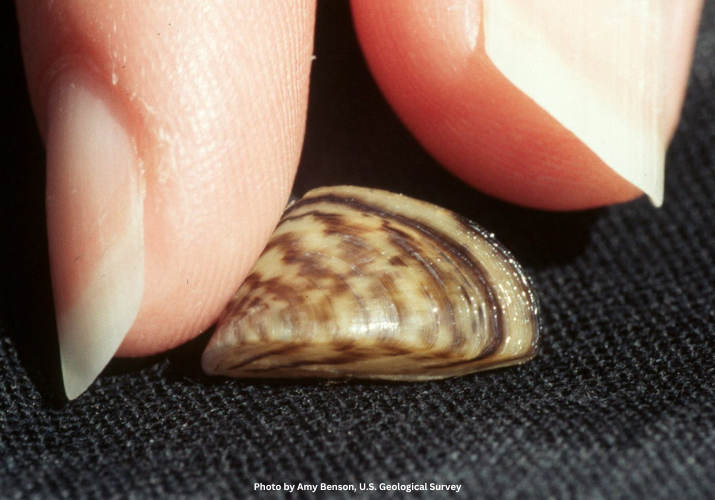
Zebra mussels disperse widely because they breed fast: an adult female produces 30,000 to 40,000 eggs in each reproductive cycle, and up to 1 million eggs per year. Their microscopic larvae, called veligers, can drift freely throughout the water column for weeks before finding a surface where they can latch their fine yet durable byssal threads, creating an epoxy-like bond. The mussels attach to any hard surface, including water infrastructure where they clog pipes and drive up maintenance and repair costs, docks and rocks where they scrape swimmers’ feet and boats’ hulls, and historic shipwrecks where they corrode iron components.
Zebra mussels spread between waterbodies by attaching to boats and other equipment, and from veligers in ballast water—the latter being how they came to North America from their native home in the Black and Caspian Seas. With the right conditions, zebra mussel populations can become incredibly dense, often over 10,000 individuals per square meter.
The ecological impact of zebra mussels is hard to overstate. An adult can filter feed over a liter of water per day, consuming zooplankton and other microscopic organisms. This creates crystal-clear waters that reflect not a healthy lake, but an aquatic food web in peril, as fewer nutrients are available to other benthic organisms and fish. Greater water clarity allows light to penetrate deeper, fueling excessive plant and algae growth. Zebra mussels resist large-scale management efforts, and while small-scale management can clear up little bays and beaches, veligers resettle quickly.
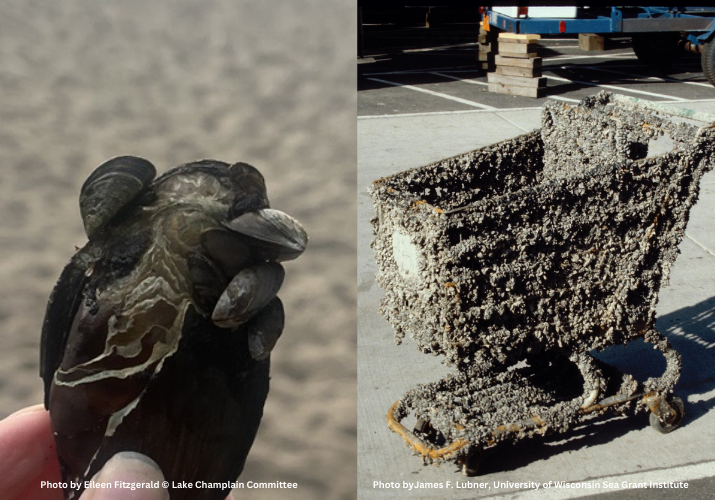
If zebra mussels are bad, Lake Champlain does not want to meet their cousin: the quagga mussel (Dreissena bugensis), an invasive mollusk also belonging to the family Dreissenidae and discovered in the Great Lakes in 1989. These two invasive mussels have much in common: they are native to the same region and were introduced to North America in ballast water through the St. Lawrence Seaway. They are similar in appearance, have comparable effects on recreation, economies, and ecological function, breed prolifically, and defy most known management strategies.
A few key differences make the quagga mussel an even greater adversary to lake health. Zebra mussels are typically not found at depths greater than 60 feet, while quaggas can survive more than 400 feet underwater. Deeper parts of Lake Champlain now untouched by zebra mussels, and the preserved shipwrecks resting there, would be susceptible to quagga mussel infestation. Quaggas also don’t require firm surfaces, readily growing on both soft and hard foundations and putting sandy beaches and muddy shorelines at risk. Greater depth and wider substrate tolerances make quaggas even more effective invaders than zebra mussels, amplifying their negative impacts. While the two species can co-exist, quaggas have been found to outcompete zebra mussels in waterbodies where they overlap.
Good news: quagga mussels have not been detected in Lake Champlain—yet. But they are at our doorstep, and if they find their way into the lake, it is vital to catch them as early as possible. The Lake Champlain Committee (LCC) leads the Champlain Aquatic invasive Monitoring Program (CHAMP) which trains and supports volunteers around the lake to identify, survey for, and report on invasive species. Volunteers learn to recognize “target” species like zebra mussels that we already know to be in Lake Champlain, as well as “watchlist” species like quagga mussels that are present in nearby waterbodies and may invade Lake Champlain. Having trained eyes on the water looking for quagga mussels and other invaders can help us catch the species before it is too late to manage them. You can get involved with CHAMP by signing up on LCC’s website.
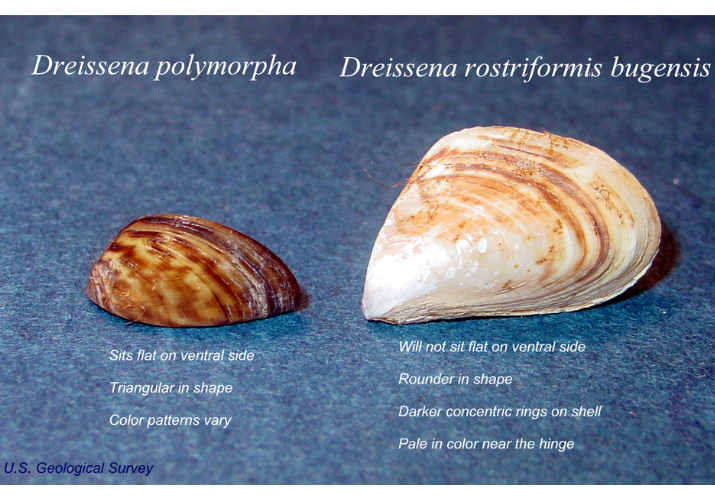
Another way to help is to make sure you’re not spreading aquatic invasive species. Invasive mussel veligers can live for weeks in a thimbleful of water, making it easy to transport them over a long distance between boating trips. Always clean, drain, and dry your watercraft, including everything that contacts the water like your anchors, anchor lines, and decks. Visit a boat decontamination station if traveling from one waterbody to another. Take a page out of Matt Toomey’s book and report an early detection: if you see something that you think is a quagga mussel (see the photo on how to distinguish them from the prevalent zebra mussel), collect a specimen, photograph it, and contact your state’s Department of Environmental Conservation. You can also email lcc@lakechamplaincommittee.org and we will report it for you.
Learn more about Zebra and Quagga mussels:
- This Lake Alive! by Amy Demarest (page 387-390)
- Vermont Ecostudies Dreissena polymorpha info page
- Invasive Species Centre's Zebra and Quagga Mussel landing page
- Zebra Mussels and Their Impact on Historic Shipwrecks by the Lake Champlain Maritime Museum
LCC’s Champlain Aquatic invasive Monitoring Program is funded by LCC donors, the Lake Champlain Basin Program (LCBP), and NEIWPCC. Thank you to Meg Modley from LCBP for providing some of the information in this column.
Lake Look is a monthly natural history column produced by the Lake Champlain Committee (LCC). Formed in 1963, LCC is a bi-state nonprofit that uses science-based advocacy, education, and collaborative action to protect and restore water quality, safeguard natural habitats, foster stewardship, and ensure recreational access. You can join, renew your membership, make a special donation, or volunteer to further our work.