Mercury’s Journey to Lake Champlain’s Fish
February 2026 Lake Look
If you’ve ever eaten or thought about eating fish, from Lake Champlain or otherwise, you have likely been warned of mercury. But how does mercury get into fish in the first place, and what does that mean for public and environmental health in the Lake Champlain watershed?
Mercury is an element that does not break down. It occurs naturally as a trace mineral in water, soil, and rocks and becomes airborne when rocks break down, as soil decomposes, and through volcanic activity. Mercury is then deposited back into water and soil over time.
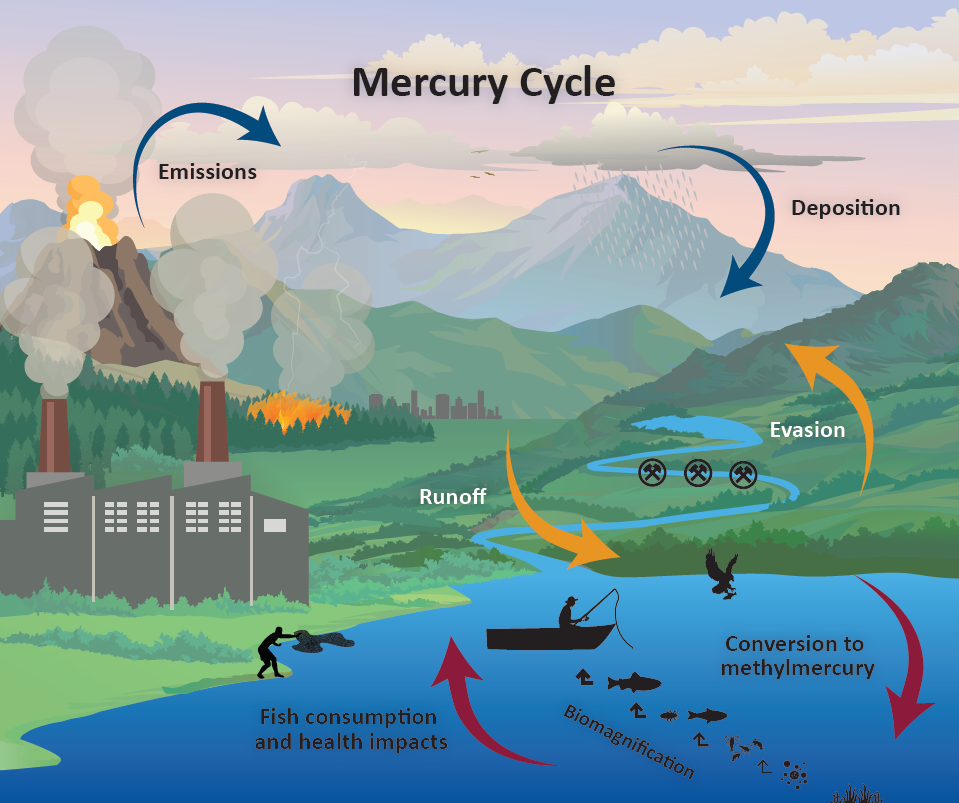
The pace and scale of this process changed dramatically with the Industrial Revolution in the 19th century. When we burn wood, fossil fuels, or municipal waste, we release mercury into the atmosphere. With the magnitude of combustion that’s happened over the past century and a half, we’ve mobilized large quantities of mercury into the atmosphere that was previously stored in the earth.
How does mercury work its way from the air into the fish of Lake Champlain? First, it must get into the water. This happens in two ways: one is directly through precipitation, which is called “wet deposition.” It can also happen indirectly as plants take in mercury from the air during photosynthesis. As leaves fall and decompose, mercury enters the soil, and then that soil can be washed into waterways as runoff.
Now in the water, elemental mercury is transformed into methylmercury, an organic compound that is highly toxic to wildlife and to humans, by bacteria or algae. Methylmercury enters the food web when the bacteria or algae are consumed by tiny aquatic animals, or zooplankton, which in turn are tasty treats for successively larger organisms including fish. Fish are efficient at taking in methylmercury but not as good at excreting it, causing the compound to build up in their tissues over time in a process called bioaccumulation. As a fish ages and grows, more and more methylmercury will bioaccumulate in its body.

Aquatic food webs can be highly complex, but the principle of “big fish eating the little fish” stands true. For example, a young smelt may eat zooplankton that contains methylmercury. Later, an adult perch eats the smelt, and then a walleye eats the perch. As these species eat each other, methylmercury is transferred up the food chain, and the concentration increases in each successive step in a process called biomagnification. Species that consume an organism with methylmercury can amass concentrations of the toxin up to ten times higher than what they ate.
Methylmercury is a neurotoxin in humans and has adverse health effects when consumed in large amounts, but eating fish from Lake Champlain can be a part of a healthy diet. Safe consumption of fish comes down to quantity and at what point you enter the food chain. New York, Vermont, and Quebec each issue safe fish consumption advisories. Children and people who are pregnant have lower recommendations because of higher sensitivity and risks associated with mercury poisoning. Species such as yellow and white perch, generally smaller and lower on the food chain, have lower levels of mercury than species like lake trout and walleye, so these are recommended as safer species.
Water chemistry and hydrology also affect mercury concentrations. Research presented by Dr. Vivien Taylor of Dartmouth College found that yellow perch in Malletts Bay had significantly higher mercury levels when compared to those sampled from the Missisquoi Bay and the Inland Sea. Malletts Bay is deep—over 100 feet at maximum and half of its total depth over 50 feet. The high water volume dilutes nutrients. The opposite is true for Missisquoi Bay and the Inland Sea: Missisquoi Bay has a maximum depth of only 14 feet and high nutrient concentrations. Mercury levels in the water may be similar, but with more algae growth in the shallow, nutrient-rich bay, methylmercury is diluted amidst a higher biomass. Meanwhile, less algae in the deep, nutrient-poor bay means a higher concentration of the toxic compound.

The good news is that since its boom in the early 20th century, mercury deposition in our region has declined following the passage of the Clean Air and Clean Water Acts in the 1970s. However, there has been stagnation in the past 20 years—while there is less wet deposition directly from atmospheric mercury, there may be more dry deposition happening as more runoff shakes loose older mercury deposits from the soil and into the lake.
For anglers, it is important to adhere to fish consumption advisories and to limit the number of larger fish from the lake you eat. For those who want to keep mercury out of our waters, watershed management is key. Dr. Taylor emphasized the importance of river deltas in sequestering mercury before it enters the food web—protecting deltas and other wetland complexes helps lower mercury levels in the lake, and protects us and our environment from the impacts of flooding while acting as crucial habitat.
Thank you to Dr. Vivien Taylor of Dartmouth College for sharing her research, and to Lake Champlain Sea Grant for facilitating her research presentation “Mercury bioaccumulation in the deep and shallow basins of Lake Champlain.”
Lake Look is a monthly natural history column produced by the Lake Champlain Committee (LCC). Formed in 1963, LCC is a bi-state nonprofit that uses science-based advocacy, education, and collaborative action to protect and restore water quality, safeguard natural habitats, foster stewardship, and ensure recreational access. You can join, renew your membership, make a special donation, or volunteer to further our work.