What Can We Learn From the Rain?

Stormwater and Stewardship at the Georgia Elementary and Middle School
September 2026 Lake Look
School is back in session, and students throughout the Lake Champlain watershed will be looking out from classrooms as autumn showers drench their campuses. Rain that falls in a forest or on natural vegetation has the chance to infiltrate into the ground and be absorbed by plants’ roots, but rain that falls on a school is likely to become polluting stormwater runoff. Through the work of a team of partners over the past year, students in Georgia, Vermont, had the chance to learn about stormwater pollution at their school – and to take steps to reduce it while educating their community.
School campuses with their paved parking lots, buildings, and sidewalks contain a lot of impervious surfaces—hard areas that block water from soaking into the ground. As hubs for education and community gatherings, schools present an opportunity to learn about stormwater and implement solutions. During the 2025-26 school year, the Lake Champlain Committee (LCC) partnered with students and educators at Georgia Elementary and Middle School (GEMS) as well as Lake Champlain Sea Grant through the Vermont Green Schools Initiative to pair classroom and community learning about water quality with stormwater reduction projects on campus. The GEMS Middle School Youth Leadership Team embarked on a year-long project to learn about stormwater and what it means for Lake Champlain, then to share their learning with other students and the broader community.

Stormwater is water from precipitation or melting ice and snow that moves over the landscape. As it flows, stormwater collects whatever is on the ground or in the soil that can be conveyed by water—including nutrient-laden sediments, bacteria, chloride, and other pollutants—and becomes runoff. In our watershed, that runoff eventually ends up in Lake Champlain.
In Vermont, many sites with three acres or more of impervious surface must install systems that capture and treat runoff. Green stormwater infrastructure (GSI) seeks to mimic natural water systems and slows the flow of runoff by capturing, absorbing, and filtering it. GSI uses plant and soil systems, permeable surfaces, stormwater harvesting and reuse, or landscaping to reduce runoff. This approach includes infrastructure like rain gardens, permeable pavement, rain barrels, green roofs, bioswales, and gravel wetlands.
Through the Vermont Green Schools Initiative, many schools in Vermont that fall under the three-acre rule had GSI built into their campuses in the past couple of years. GEMS was one of these schools—in the summer of 2025, students and teachers arrived back at school to see what appeared to be a hole in the ground where trimmed GEMS hedges and trees once stood. The “hole” was a carefully engineered gravel wetland designed to infiltrate stormwater runoff – but its purpose was difficult to discern as its plantings had not thrived due to the 2025 drought. LCC and the GEMS Youth Leadership Team worked over the course of the school year to support the establishment of native plants and vegetation in the gravel wetland and to develop educational signage to cultivate a place to learn about water and celebrate stewardship.
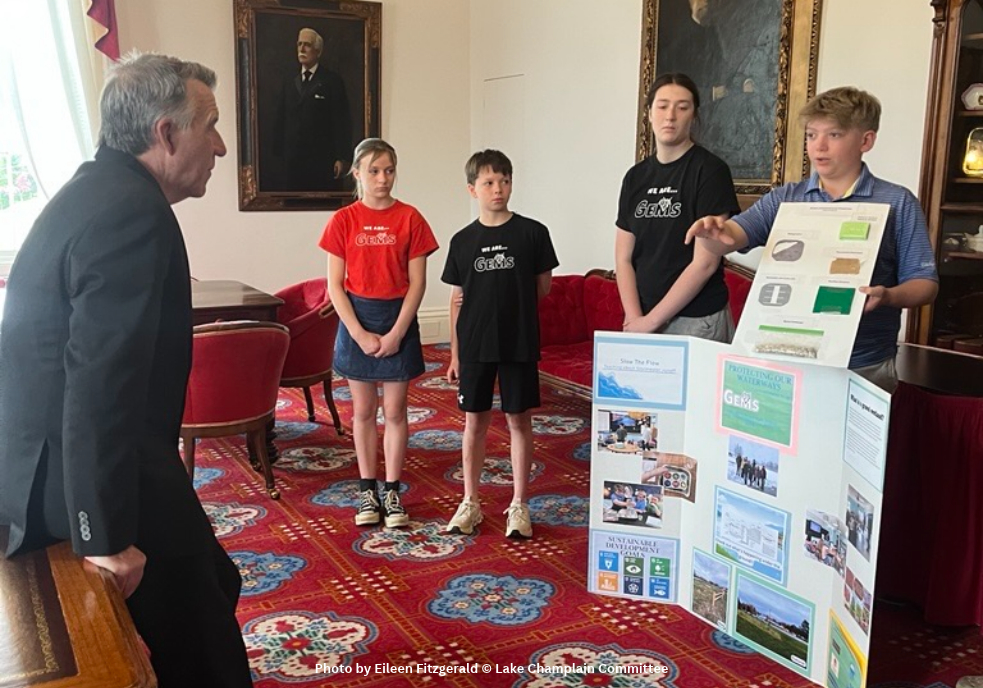
Over the course of the year, students learned about stormwater runoff, how green infrastructure works, and how they both relate to Lake Champlain’s water quality. The Youth Leadership Team shared what they learned with the school community, writing blog posts, doing stormwater runoff activities with younger students, and helping design a permanent sign that will explain to visitors how gravel wetlands work. The team worked with a local landscaper to research native plants and design plantings in and around the gravel wetland. With shovels, mud, and high spirits, they planted the wetland in May and hosted an open house with parents and community members to learn about the project in June. The students had the opportunity to present their work at the Vermont Statehouse to schools throughout the state and to Governor Phil Scott as a part of the Shelburne Farms Cultivating Pathways to Sustainability program.

As this school year begins, the gravel wetland will greet GEMS students, teachers, and families looking more like a wetland, with native plants soaking up runoff, hosting pollinators, and sporting fall colors. LCC looks forward to working with the Youth Leadership Team to install the permanent interpretive sign and make sure the plants are healthy. We hope to do more work with stormwater and GSI at schools throughout the Lake Champlain watershed!
Thank you to partners involved in this project: The Lake Champlain Sea Grant, Vermont Department of Environmental Conservation, Shelburne Farms, Maddocks Landscaping, Greenleaf Designs, and the amazing educators and personnel at GEMS who helped make this happen, including Karen Lehning, Scott Thompson, Eric Hadd, Jeff Hamel, and the third and fourth grade educator team. This project has been funded wholly or in part by the United States Environmental Protection Agency under assistance agreement (LC00A01526) to NEIWPCC in partnership with the Lake Champlain Basin Program.
Lake Look is a monthly natural history column produced by the Lake Champlain Committee (LCC). Formed in 1963, LCC is a bi-state nonprofit that uses science-based advocacy, education, and collaborative action to protect and restore water quality, safeguard natural habitats, foster stewardship, and ensure recreational access. You can join, renew your membership, make a special donation, or volunteer to further our work.